


Seoul Urban Architecture
Rising from the Crushing Bowl
GVA Gemeinsame Verlagsauslieferung Göttingen
GmbH & Co. KG
P.O. Box 2021
37010 Göttingen
Germany
+49 551 384 200 0
info@gva-verlage.de
Seoul Urban Architecture is a powerful and original study of Seoul’s urban and architectural evolution, told through the lens of an architect and educator who has lived and worked in the city for over four decades. In his book, which is part memoir, part cultural history, and part urban analysis, Sung Hong Kim traces how South Korea’s capital—once a walled city shaped by Confucian ideals—has become a sprawling, vertical metropolis marked by rapid modernization, deep structural contradictions, and a fierce, creative resilience.
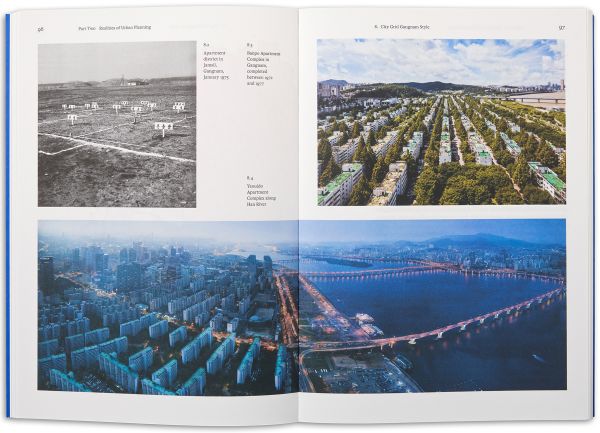
Organized into four parts, Kim surveys Seoul’s urban landscape from the late 14th century to the aftermath of the Korean War, illuminating the layers of occupation, destruction, and imposed planning that have shaped the city’s foundation. He guides the reader through periods of urban, legal, technological, and cultural constraints that eventually gave birth to new vitality, creativity, and innovation from an emerging generation of architects. His reflections on displacement, constraint, and ingenuity speak to a broader global condition faced by architects and urban designers alike: how to find meaning and agency within environments shaped by forces beyond their control.
At once personal and panoramic, Seoul Urban Architecture offers a vital perspective on this city of paradoxes, where fragments of history coexist with radical new forms, and where the uneven fabric of urban life reveals the story of a nation that has risen, in several bursts, from the ruins of war and colonization to become a cultural and economic powerhouse.
"The book offers a rare attempt to synthesize over six centuries of Seoul’s urban history for an international readership. " Park Yuna, The Korea Herald
"Seoul Urban Architecture demonstrates that, at its best, design can shape the material consequences of policy to the benefit and enrichment of life in common." John Peponis, School of Architecture, Georgia Tech, Atlanta
"This is Sung Hong Kim’s achievement: to explain why there are these particularities [of Seouls development] and to make it clear to the reader that the convulsive histories – the colonialization by the Japanese, the war of the 1950s – had a major impact on, on one hand, influencing the development of urban architecture and design, but as well as clearing the path for modern civil architecture and urban design." Wilfried Wang, Tongji University & Hoidn Wang Partner